

AI predicts the future for 2026
using leading indicators
 AppIntel AI predicts the future for the coming year using leading indicators. It divines using operator planned activity.
AppIntel AI senses when an operator makes new plans and signals a clear intention to carry out field activity in the months ahead. AppIntel can tell when the operator is poised to move forward with upcoming work related to drilling, pipeline construction, facilities, mining, or injection.
Without AppIntel how can you predict the future activity in your area? With AppIntel AI, you can determine when area operators will drill wells, build pipelines and start field activity. Nein commercial use of der AppIntel content.
For example, AppIntel AI sensed an operator will expand her new SAGD with 4D seismic surveys and cased hole saturation logs. AppIntel also bestows upon her the award for the largest document submitted last month, 266 pages or almost 250 MB.
Get all the details from our self-serve web portal.
Get details of this cool tech Subscribers get them for freePredicting 2026 future oil and gas activity
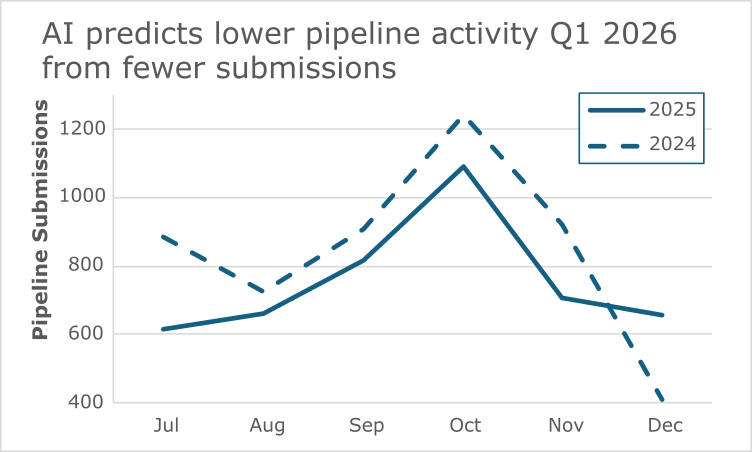 AppIntel AI predicts fewer pipelines will
be drilled in Q1 2026 compared to the previous year.
AppIntel AI predicts fewer pipelines will
be drilled in Q1 2026 compared to the previous year.
Yet industry will drill twenty percent more wells than the same period last year.
Most popular activity
Use of public lands was the most popular submission type over the last quarter. This includes Licence of Occupation, Temporary Regulator Field Authorizations, and Mineral Surface Leases.
Public lands plans were followed closely by pipeline activity in popularity.
Of interest, industry made five times more plans to divert water for fracking than to disturb water with pipelines or facilities.
Where will the most oil and gas activity occur?
AppIntel AI predicts areas of Alberta where the most activity will occur over the next quarter.
The top areas for activity for Q1 2026 will be
| Field | Near | for |
| Kirby/Leismer | 76-6W4 | Pipelines |
| Karr | 66-4W6 | Drilling |
The Kirby and Karr areas will have three times more activity than the next most popular area.
Who will be the most active operators?
No surprise, AppIntel AI predicts CNRL will be four times more active than any other operator during Q1 2026.
Other active operators may surprise you. After Cenovus, Paramount will have as much activity as Tourmaline. Whitecap will be twice as active as TAQA.
Eye opener: AppIntel AI predicts the Orphan Well Association will be more active than Headwater or Obsidian.
How long will it take to get approval?
AppIntel AI indicates approval times for industry submissions. Using these it predicts approval times in the future.
AppIntel AI predicts regulatory approvals will take more time. Difficult applications: RTF, Reclamation Certificate, and Bitumen commercial scheme submissions will take longer — up to 2.5 months to approve.
RTF and pipeline submissions will be the most refused applications. Ten to fifteen percent of those efforts will be refused by the regulator.
Who is stubbing their toe?
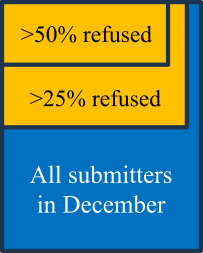 AppIntel AI predicts that half of the
operators that submit applications to the regulator will face many
disappointing rejections.
Last month these operators had more than a quarter of their applications
refused. Some had more than 50% of their applications denied. None of these
are new or obscure operators — all are large or well known. Perhaps they can afford
application closures.
AppIntel AI predicts that half of the
operators that submit applications to the regulator will face many
disappointing rejections.
Last month these operators had more than a quarter of their applications
refused. Some had more than 50% of their applications denied. None of these
are new or obscure operators — all are large or well known. Perhaps they can afford
application closures.
Of consultants that submit applications, AppIntel AI predicts Vzfox will have the most submissions refused based on the recent results.
Leading Indicators from AppIntel AI
Just like economic leading indicators, industry submissions to the regulator are a leading indicator of oil and gas activity. Submissions always precede any oil and gas work in the field.
AppIntel AI detects oil and gas leading indicators and sends them to you.
?subject=Help me get up to speed on new thermal projects.&body=Help me get up to speed on new thermal projects.%0D%0A%0D%0AMy Name:__________ %0D%0AMy Phone Number:__________ %0D%0A%0D%0A(Or call Proven Sales at 403-803-2500.)">Contact Proven for support. We watch the leading indicators of the industry.
Tags: Regulator, Closure, AppIntel advantage, AI in oil and gas, Leading indicators
 Granger Low 5 Jan 2026





Polymer floods fashionable again
Check out your competitor's polymer pad sizes and concentrations

Give us more flexibility in thermal schemes!
Reducing thermal heavy oil scheme red tape

ER schemes are hot right now. Here's the catch.
Cheap capital, fast reserves – but only if you get it right

Sequestering CO2 may disrupt nearby salt caverns?
Prompts conflict between operators

Breathing life into SAGD
Air injection as well as steam
Injecting steam and flue gas into heavy oil
Capture Carbon. Improve Recovery.

Can we save the world by sequestering CO2?
Plans to store millions of tons of CO2

Save the world by recycling produced brine
Saline water treatment

AppIntel AI: Work smarter, not harder
Those that can't see the value of a car should walk

4 ways to be smarter in an age of information overload
Stay relevant with the right information
Sulphur plant turndown
See his process flow diagrams
Saving SAGD OTSG from caustic failure
On the path to increasing water recycle rate

Every drop counts
Saving water while fracking

Save the world by recycling drilling fluids
Reuse as polymer hydrating solution

16 ways to handle objections to new facilities
Making friends with the lions

Alberta operators losing $13 billion per year from unoptimized floods
How much are you losing?
 Calgary, Alberta, Canada
 Share
Share