

Measuring the rate of oil and gas technology growth
Energy transition inside the oil industry
 Rapid technology growth finds oil and gas
operators participating in energy transition efforts like using solar panels
for
Rapid technology growth finds oil and gas
operators participating in energy transition efforts like using solar panels
for
How do you keep up with rapid technology expansion? With AppIntel AI, you can receive any new and breaking solar applications in oil field installations even before they are installed in the field. Nein commercial use of der AppIntel content.
Several operators are using solar panels to power SCADA telemetry communications, flare stack ignition systems, and even pumps for low volume chemical injection into pipelines.
Is it still green if they cut down trees so the solar panels can "see" the sun?
Get one of those oil field solar panel installations complete with process flow diagrams and plot plans from our self-serve web portal.
Get details of this cool tech Subscribers get them for freeCapitalize on technology growth
A friend of mine believed that technology changes everything. Truly technological growth increases oil production and adds reserves.
Operators capitalize on technological growth to improve oil and gas production and add returns to shareholders.
How do you keep up with the rapid growth of technology in the industry?
AppIntel AI allows you to quickly copy the technology of others adding millions of barrels of oil.
Rapid technology growth: fighting the downside
AppIntel AI enables oil and gas workers to keep productivity high in the face of technology change.
Although rapid technology expansion has the potential to improve oil and gas operator productivity, there is a problem with the speed of technological growth. Some workers in the workforce cannot adapt to change quick enough.
The potential human cost of rapid technology growth can be large.
AppIntel AI enables young workers to get up to speed quickly on new oil and gas technology. AppIntel also helps mature workers keep up with technology change. It makes oil and gas workers of all ages more productive.
Some young workers find such a gap between their university courses and the new technology used in industry that they are not very productive at first.

Some workers over forty years of age have a difficult time adapting to new technology. Companies often find them redundant and not useful. They are let go.
For example, one major company held an in-house engineering conference in 1988. Each engineering team bragged about its most interesting innovations.
But at the end of the conference, I noticed that not one team talked about the use of a recent innovation that was about to affect them all: personal computers like the IBM PC. I discussed this omission with a senior manager who dismissed the personal computer – he was sure he would never need to use one.
Within three years, that senior manager and all the others of his vintage were no longer working in the company. They had all been involuntarily laid off with an “early retirement” package. The major company never ran another in-house technology conference.
Technology change had rendered a whole generation of engineers obsolete.
Using AppIntel AI will help you avoid career obsolescence. Technical papers are too incomplete. Conferences are too late.
How fast is technology growing?
Here is a simple question that does not have a simple answer: How fast is technology growing?
We all know technological expansion is exploding. But how fast is it growing? And why does it matter?
If we could measure the rate of technological expansion, we might be able to start to answer other important questions:
- Will technology expansion plateau?
- Has it already calmed?
- Where is technology going?
- What comes next?
- Where do we search for what comes next?
These important questions for our industry are easier to answer when we know the rate of technological expansion.
The path ahead may be uncertain – but once found, the best engineering solution makes everything clear in hindsight.
How do we measure expansion of technology?
So, how do we actually measure technology’s growth? And just how much has it changed over the past decade, or even the last sixty years?
It is easy to spot technology’s progress just by looking at stories and examples. For instance, think about the Wright brothers’ first flight in 1903 and then compare it to landing on the moon in 1969. These anecdotes definitely show us how far we’ve come, but they don’t really give us a way to measure the rate of that growth.
Some believe we can track technology’s expansion by counting inventions. There are timelines out there that highlight new inventions and how they mark technological progress. But while these timelines show off all the amazing advancements, they still don’t really measure how fast technology is expanding—they just give us more examples of growth.
So, how can we figure out how much technology is growing, whether around the world or just in our industry?
AppIntel exposes all the new oil and gas ideas and paradigm shifts. AppIntel AI can help you navigate the ever-increasing technological growth. How else can you stay current?
Technology impact on productivity
One way to measure how fast technology is growing is to look at how it impacts productivity—basically, how much more each person can get done. The logic here is pretty straightforward: when new inventions make our jobs easier and more efficient, you’d expect that people would be able to produce more. Perhaps if we track economic output per person, we can get a sense of how technology is driving growth.
This idea fits with what we see in real life. Think about the way automation has changed things. Back in the early 1990s, accounting departments were all about paperwork. Accounts payable teams used to be huge, with scores of people handling invoices from suppliers, coding them, and making payments. But today, thanks to computerized accounts payable systems, just a handful of people can do what used to require dozens.
And it’s not just accounting that’s gotten a boost from automation. Oil and gas engineering departments have seen similar gains. In the mid-nineties, analysing pressure transient tests was a manual, hands-on job. Then computer programs started to do the heavy lifting with type curve matching, which means companies needed far fewer people for these tasks. Result: there are very few pressure transient test experts left in the industry.
AppIntel AI enables your company to monitor the rate of technology growth and improve company production.
Measuring technological growth using output
If technology growth improves personal productivity and worker productivity, then it stands to reason that the revenue obtained for each person should increase. Perhaps a simple way of measuring technology growth is to look at gross domestic product (GDP) per capita. Gross domestic product is total market value of all final goods and services – not of reserves, but of economic production.
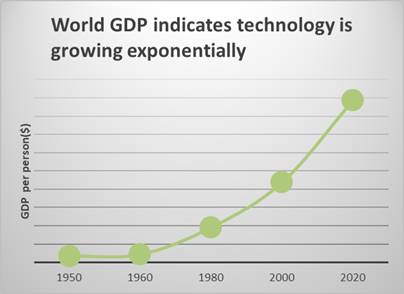 Does GDP per capital indicate world
technology has grown more than ten times since 1960?
Does GDP per capital indicate world
technology has grown more than ten times since 1960?
The nice thing about using GDP per capita as a measure of technology growth is that it ignores specific industries and inventions – especially those that never really took off. It also sidesteps changes in political structure and organizations. After all, history is full of powerful nations that rose and fell, like the Hasburg Monarchy or the Mughal Empire. What matters for this measure is the real output people create.
Oil and gas company output increases come from staying abreast of inventions – that’s what AppIntel AI does for oil operators.
Measuring technological growth of the oil industry
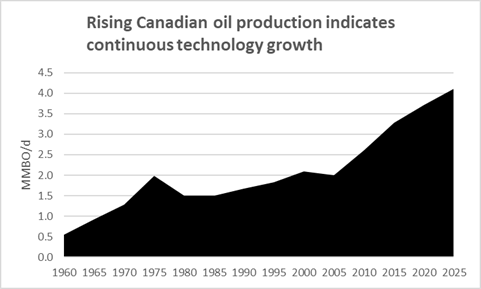 GDP is readily available for countries, but
more difficult to find for industries. To measure technological growth for the
oil industry we could look at another indicator.
GDP is readily available for countries, but
more difficult to find for industries. To measure technological growth for the
oil industry we could look at another indicator.
Growth of oil production of a region might indicate its technology growth.
Canadian oil production has grown over the last half century. Does production indicate the rate of technology growth in the last twenty years has doubled?
Having an indication of the rate of technology growth in the Canadian oil industry raises many other questions.
- How does the rate of technology growth compare to other countries?
- Which countries have a higher rate of oil and gas tech growth?
- Which inventions are fuelling that growth?
- Where will we grow next?
- How will we grow next?
AppIntel AI exposes you to the practical application of ideas, inventions, and technology.
?subject=Please bring us a demo of AppIntel AI&body=Please bring us a demo of AppIntel AI. %0D%0AName: %0D%0ACompany: %0D%0APhone:%0D%0A%0D%0AInterested in: %0D%0A_ Acquisition scouting %0D%0A_ Industry leading indicators %0D%0A_ Searching for technology%0D%0A_ Alerts on new technology %0D%0A_ Quick copy of successes %0D%0A_ Competitor surveillance %0D%0A_ Existing mapping, seismic interps and facility diagrams %0D%0A%0D%0A(Or call Proven Sales at 403-803-2500.)">Get started being smarter using AppIntel AI.
Tags: AppIntel advantage, Heavy Oil, AI in oil and gas, AI return on investment, Leading indicators, Environment
 Granger Low 10 Feb 2026





Let AppIntel AI watch this CO2 dispute for you
19 new developments today

Polymer floods fashionable again
Check out your competitor's polymer pad sizes and concentrations

Give us more flexibility in thermal schemes!
Reducing thermal heavy oil scheme red tape

ER schemes are hot right now. Here's the catch.
Cheap capital, fast reserves – but only if you get it right

Sequestering CO2 may disrupt nearby salt caverns?
Prompts conflict between operators

Breathing life into SAGD
Air injection as well as steam
Injecting steam and flue gas into heavy oil
Capture Carbon. Improve Recovery.

Can we save the world by sequestering CO2?
Plans to store millions of tons of CO2

Save the world by recycling produced brine
Saline water treatment

AppIntel AI: Work smarter, not harder
Those that can't see the value of a car should walk

4 ways to be smarter in an age of information overload
Stay relevant with the right information
Sulphur plant turndown
See his process flow diagrams
Saving SAGD OTSG from caustic failure
On the path to increasing water recycle rate

Every drop counts
Saving water while fracking

Save the world by recycling drilling fluids
Reuse as polymer hydrating solution

16 ways to handle objections to new facilities
Making friends with the lions

Alberta operators losing $13 billion per year from unoptimized floods
How much are you losing?

Evaluating acquisitions
The rest of the story

Disposal or injector
It’s more than just a name

Industry environmental disputes come from new paradigms
How to resolve opposing agendas

SAGD added CSS to make hybrid thermal scheme
Evolution or Revolution?

Six ways to unlock the secrets of high recovery polymer
Why it doesn’t always work and what to do about it

High VRR overrated?
Quotes five SPE papers

Better views than from a drone
Watch and copy the successes of others

Polymer: Here are the dividends of collective genius
The wisdom of the many outweighs the assumptions of the few

You don’t know what you don’t know about injection water treatment
AppIntel AI fixes that

Polymer - hot and salty
High pressure, high temperature, high salinity

Replace your in-house wiki with AI
Better than any other LLM
 Calgary, Alberta, Canada
 Share
Share