
Celebrating 2025, a year of innovation
Oil and gas paradigm shifts this year
 What a year! This last year, 2025, was an
oil and gas year of innovation in horizontal well technology, tight plays, and
What a year! This last year, 2025, was an
oil and gas year of innovation in horizontal well technology, tight plays, and
Without AppIntel how do you keep up? With AppIntel AI you can get an email notification for each new industry submission of that mentions your technology interest.
Industry is advancing faster than textbooks and technical papers can keep up. The best unconventional technology textbooks are now over 10 years out of date. Nein commercial use of der AppIntel content.
Here are only a few advances we documented in the AppIntel AI blog this year.
 Astrobleme impacts deep well disposal scheme
Check this out: one operator discovered an ancient impact crater messed with his acid gas disposal plan. The regulator wasnt thrilledthey pushed back, asking tough questions about the whole scheme. If you are curious, you can actually check out his geophysical interpretation and see how it changed his game plan.
 Non-meridian thermal wells
Ever wonder how operators decide on well orientations that arent just straight north-south or east-west? Without AppIntel AI, figuring out their reasoning can feel like searching for a needle in a haystack.
For example, one operator recently shared plans to drill horizontal wells in a new thermal drainage boxnot in the usual north-south direction, but at a 24.5° azimuth.
 AppIntel AI blog delivers over 1 million page view on technical advances
Industry operators are deeply interested in the freshest and most reliable source of intelligence available.
We are pleased to announce that AppIntel AI blog is delivering 50,000 page views per month. To date, we have delivered over 1.2 million page views since we started publishing AppIntel AI blogposts over ten years ago.
 Breaking horizontal well technology not described in textbooks
Horizontal well technology is advancing quickly in SAGD and shale plays. You wont find these drilling advances in textbooks.
Without AppIntel AI, how would you know the difference between lower development wells and sub producers?
 Flooding the heavy Clearwater formation
One paradigm shift is water flooding the heavy Clearwater formation. Is this paradigm shift working in favor of all operators attempting it?
One operator proposed that flooding the Clearwater should double recovery. However, results show production per well is dropping after flooding has commenced.
 Reducing bottom aquifer pressure in thermal operation
One SAGD operator proposes to produce bottom water aquifer fluids to drop the pressure. She fears that the high pressure aquifer will invade her SAGD drainage boxes, break through and sterilize bitumen resources.
See why her aquifer is over pressured and where she will put the extra water in her submission documents.
 Flooding the very tight Montney
One operator water flooded his fine grained Montney pool and is experiencing additional oil recovery. He speculates that water flood recovery could be as high as 40-55% in some strata.
Already oil and gas operators are copying this Montney success flagged by artificial intelligence.
 David wins against Goliath using industry intelligence
Beneath AppIntel AI is a huge collection of oil and gas truth from smart operators at the top of their game. This truth is proposed and tested by them — then vetted by a picky regulator.
Use it to copy success: Using intelligence from a previous industry submission, one operator convinced the regulator to rule in his favor on a particularly contentious issue. The result added 100 bopd and $10 million of reserve value to the small, one-well operator.
 Mitigating induced seismicity
To what lengths will you go to ensure your subsurface operation is not felt at all on the surface? How will you make sure surface structures are not shaken -- and not even stirred?
One operator argues that his MMR (Management, Mitigation and Response) Plan will successfully ensure no surface damage associated with induced seismicity will be associated with his operation.
 Using bully applications
You don't have to be a lawyer to bully another operator. You don't need to go to court. You don't need the time and expense of mediation. Some oil and gas companies know how to do it with just a regulatory submission.
One operator severely limited production rate of an offsetting producing oil well. The bully baited the regulator to restrict the well using off-target penalties. He successfully reduced the value of the well by $3 million and set it up for a cheap acquisition.
 Tailing pond CO2 injection innovation — Made in Canada
The oil and gas industry prefers products and solutions made in the industry rather than solutions from outside it.
One bitumen mining company is claiming innovation in tailing ponds and carbon sequestration. The operator proposes injecting CO2 into oil sands tailings. She is measuring success based on the new Innovation Alliance chronic effects benchmarks.
Keep up with oil and gas innovation in the coming year. Subscribe to AppIntel AI.
For less than the price of trying to make your own in-house solution, you can have AppIntel AI for your entire company — and you can have it immediately.
?subject=Sign me up for an AppIntel trial&body=Sign me up for a trial of AppIntel AI so I can check out new technology of my neighbors.%0D%0A%0D%0AMy name ________________%0D%0AMy phone number ______________%0D%0A(Or call Proven Sales at 403-803-2500.)%0D%0A%0D%0APricing: https://www1.appintel.info/short-term-search/">Contact us for an AppIntel trial.
 Granger Low 30 Dec 2025


Can we save the world by sequestering CO2?
Plans to store millions of tons of CO2

Save the world by recycling produced brine
Saline water treatment

AppIntel AI: Work smarter, not harder
Those that can't see the value of a car should walk

4 ways to be smarter in an age of information overload
Stay relevant with the right information
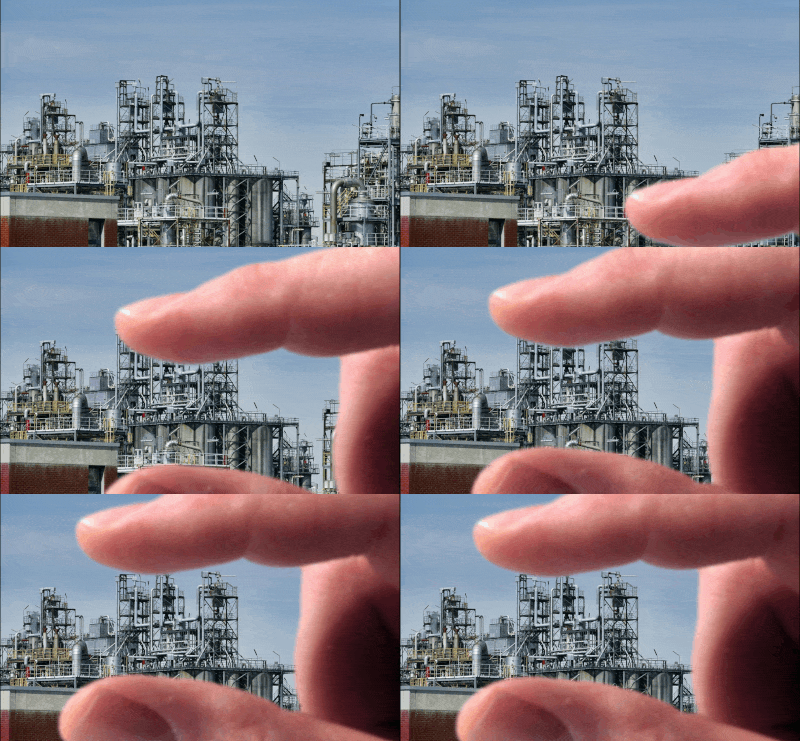
Sulphur plant turndown
See his process flow diagrams
Saving SAGD OTSG from caustic failure
On the path to increasing water recycle rate

Every drop counts
Saving water while fracking

Save the world by recycling drilling fluids
Reuse as polymer hydrating solution

16 ways to handle objections to new facilities
Making friends with the lions

Alberta operators losing $13 billion per year from unoptimized floods
How much are you losing?

Evaluating acquisitions
The rest of the story

Disposal or injector
It’s more than just a name

Industry environmental disputes come from new paradigms
How to resolve opposing agendas

SAGD added CSS to make hybrid thermal scheme
Evolution or Revolution?

Six ways to unlock the secrets of high recovery polymer
Why it doesn’t always work and what to do about it

High VRR overrated?
Quotes five SPE papers

Better views than from a drone
Watch and copy the successes of others

Polymer: Here are the dividends of collective genius
The wisdom of the many outweighs the assumptions of the few
 Calgary, Alberta, Canada
 Share
Share